
WELCOME BONUS 300%
UP TO €2000 + 100
FREE SPINS
UP TO €2000 + 100
FREE SPINS
Home → Blackjack
Blackjack at Sky City Casino: Variants, Rules and Payouts
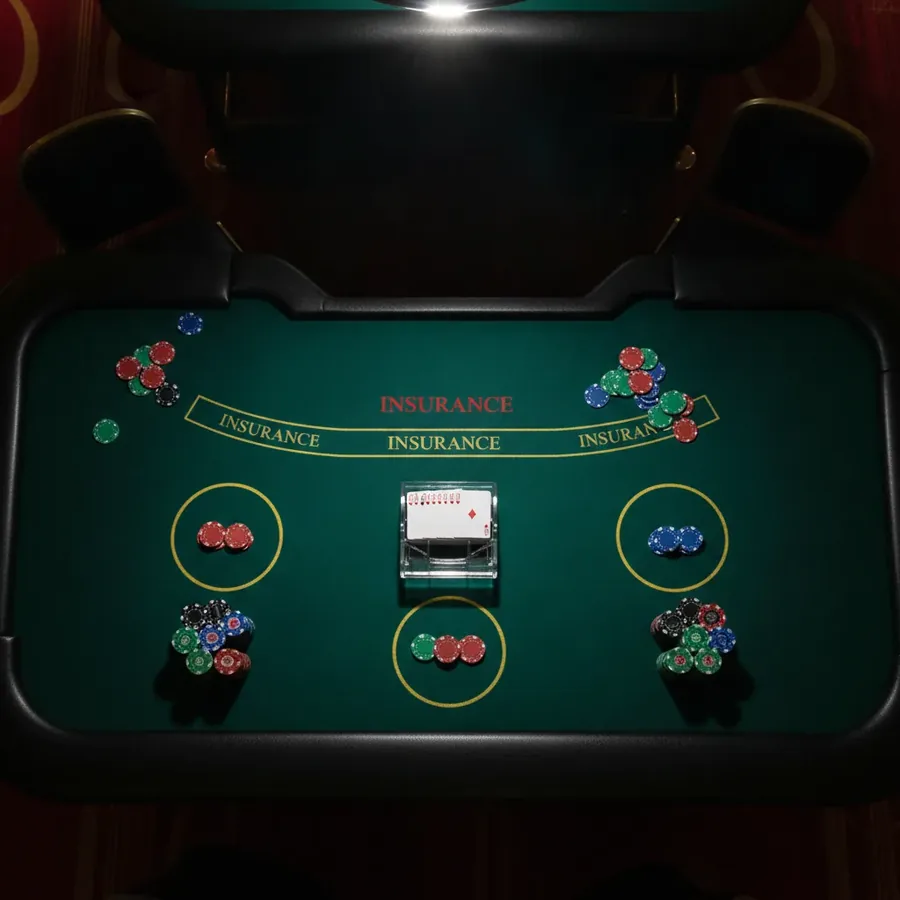
Place Side Bets Before the Cards Are Dealt
Blackjack Insurance carries an RTP of 92.53% and a house edge of 7.47% when played with six to eight decks. The side bet accepts up to 50% of the main wager and is offered only when the dealer shows an ace. Basic strategy always declines this bet because the long-run cost is far higher than the main game. A €10 insurance stake returns an average of €9.25, which makes the 2:1 payout a poor trade for most players.
The single-deck version of Insurance has a house edge of approximately 5.88%, which is lower than the 7.47% edge with six to eight decks but still expensive. Card counters consider the bet only at a true count of +3 or higher, where the remaining deck composition shifts the odds. For a beginner at Sky City Casino, the practical rule is to skip the side bet before the cards are dealt. The main blackjack hand with a 3:2 payout offers a much better expected return.
Insurance pays 2:1, so a €50 side bet returns €100 in profit if the dealer has blackjack. However, the 7.47% house edge means that over many repetitions the player loses about €3.74 per €50 staked. With a single deck the average loss drops to roughly €2.94 per €50, but that is still worse than almost any standard blackjack wager. Placing the side bet before any cards are dealt is therefore a decision that should be made rarely, if ever.
Clicked Too Late? The Hand Stands Automatically
In most blackjack games the dealer acts before the player does, so a hand that is not hit or stood on in time is resolved automatically as a stand, keeping whatever total it already holds. The rule matters most in the 6-deck, S17, DAS, DOA, 3:2 payout game, where basic strategy returns 99.54% and the house edge is 0.46%. A player who freezes on a soft 17 therefore keeps that total, while the dealer, who stands on soft 17 in this variant, does not draw to beat it.
The cost of a missed decision depends on the variant in play. In the single deck, classic rules, 3:2 game the RTP is 99.85% and the house edge only 0.15%, so standing automatically on a hand that basic strategy would have doubled wastes part of that thin margin. In the 6:5 payout game the RTP falls to 98.15% and the edge rises to 1.85%, meaning the same frozen hand costs more per round.
A late surrender option gives the player a different way out, but only before the automatic stand takes effect. Late surrender returns 50% of the stake after the dealer has checked for blackjack and improves the return by about 0.08 percentage points; early surrender is worth up to 0.6 percentage points but is extremely rare. Once the round closes, the hand simply stands at its current total.
One Deck vs Eight Decks: The House Edge Gap
Blackjack Single deck with classic rules and a 3:2 payout has an RTP of 99.85% and a house edge of 0.15%. One deck lowers the house edge by about 0.48 percentage points compared with eight decks. That difference comes directly from the changing probability of drawing matching cards. A €100 stake in the single-deck game costs an average of €0.15, while the same stake in a typical eight-deck game costs more.
The six-deck game with S17, DAS, DOA and a 3:2 payout has an RTP of 99.54% and a house edge of 0.46%. Moving from one deck to eight decks adds roughly 0.48 percentage points to the house edge, but the six-deck setup already carries 0.31 percentage points more than the single-deck version. The 3:2 payout is essential to keep these figures low. A 6:5 payout would add 1.39 percentage points to the edge.
A single-deck blackjack win pays 3:2, so a €10 blackjack returns €15 in profit. If the same table switches to a 6:5 payout, the same hand pays only €12, and the RTP drops to 98.15% with a house edge of 1.85%. That rule change costs more than the 0.48 percentage point difference between one deck and eight decks. Beginners should therefore check the payout line before counting decks.
Doubling After a Split: Which Tables Allow It
Doubling after a split, abbreviated DAS, improves RTP by about 0.14 percentage points. The six-deck game with S17, DAS and DOA reaches an RTP of 99.54% and a house edge of 0.46%. In this setup a player may double down on any first two cards and also double after splitting a pair. The rule is part of the basic strategy requirement for reaching the stated return.
Split aces usually receive one card each, and resplitting aces improves RTP by 0.08 percentage points. A split can create up to four hands, and doubling after a split multiplies the stake by two while granting only one additional card. The difference between a table with DAS and one without is 0.14 percentage points in the player's favour. On a €100 total stake that is an average saving of €0.14 per round.
The Liberal Vegas Strip ruleset includes S17, DAS, resplit and late surrender, producing an RTP of 99.72% and a house edge of 0.28%. That is only 0.13 percentage points below the single-deck classic game at 99.85%. At Sky City Casino a player should look for a table that names DAS among its rules, because the 0.14 percentage point gain is larger than the 0.08 point gain from late surrender.
Insurance vs Even Money When You Hold Blackjack
Insurance pays 2:1 and carries a house edge of 7.47% with six to eight decks, which makes it a separate side bet of up to 50% of the main wager. Even money on a player's own blackjack is mathematically the same insurance bet in disguise. When the dealer shows an ace, a player with blackjack can accept even money and lock in a 1:1 win instead of risking a push. The 3:2 payout is worth €15 on a €10 bet, while even money pays only €10.
Taking even money means the player wins €10 on a €10 blackjack instead of the regular €15 from a 3:2 payout. The expected value of declining insurance is higher in the long run because the 92.53% RTP of the side bet drags down the overall return. Basic strategy always declines insurance except for card counters at a true count of +3 or higher. A beginner should therefore never take even money on a natural blackjack.
The six-deck game with a 3:2 payout and basic strategy has a house edge of 0.46%, while insurance alone has a 7.47% edge. A player who takes even money on a €10 blackjack gives up €5 of potential profit to avoid the chance of a push. Over many sessions that decision costs more than the entire house edge of the main game. The 2:1 insurance payout does not compensate for the poor RTP of 92.53%.
Blackjack variants at a glance
| Variant | Payout | House edge | Rule | RTP |
|---|---|---|---|---|
| Blackjack Surrender (late surrender) – rule effect | 50% of the stake returned | −0.08 percentage points | The player gives up the hand after the dealer has checked for blackjack and loses half the stake. Improves RTP by about 0.08 percentage points. Early surrender is worth much more (up to −0.6 percentage points) but is extremely rare. | n/a (rule modifier) |
| Blackjack 6:5 payout instead of 3:2 (6 decks) | Blackjack 6:5, win 1:1 | 1.85% | Replacing 3:2 with 6:5 adds exactly +1.39 percentage points to the casino's edge – more than any other rule change. On a €10 bet a blackjack pays €12 instead of €15. | 98.15% |
| Blackjack Liberal Vegas Strip (liberal rules, 3:2) | Blackjack 3:2, win 1:1 | 0.28% | The most player-friendly rule set: S17 + DAS + resplit + late surrender. Standard deviation 1.15 | 99.72% |
| Blackjack Single deck, classic rules, 3:2 | Blackjack 3:2, win 1:1 | 0.15% | Fewer decks = lower edge; one deck gives about −0.48 percentage points compared with 8 decks. Often offset by a 6:5 payout. | 99.85% |
| Blackjack Split / double / H17 – rule effects | Double – stake ×2 with one card; split – up to 4 hands; split aces usually get one card each. | H17 +0.22 percentage points; RSA −0.08 percentage points; DAS −0.14 percentage points | Dealer hitting soft 17 lowers RTP by 0.22 percentage points; resplitting aces improves it by 0.08 percentage points; doubling after a split improves it by about 0.14 percentage points; 6 decks instead of 8 – about 0.02 percentage points. | n/a (rule modifiers) |
| Blackjack Insurance (6–8 decks) | Insurance 2:1 | 7.47% | Separate side bet of up to 50% of the main bet when the dealer shows an ace. Basic strategy ALWAYS declines it (except for card counters at a true count ≥ +3). With a single deck the edge is ≈ 5.88% | 92.53% |
The 3:2 Blackjack Payout Explained
A 3:2 blackjack payout returns 150 EUR on a 100 EUR stake, while a 6:5 payout returns only 120 EUR on the same amount. That gap of 30 EUR per blackjack is the price of the weaker payout, which appears on some six-deck tables.
The house edge tells the same story. The 3:2 game with six decks, S17, DAS and DOA carries a house edge of 0.46%, while replacing 3:2 with 6:5 adds exactly 1.39 percentage points to the casino's edge at six decks, raising the house edge to 1.85%. No other single rule change costs the player that much.
House edge is the average share of each stake that the casino keeps, so on 100 EUR of stakes the 3:2 game costs about 0.46 EUR and the 6:5 game about 1.85 EUR. A basic-strategy player who reaches 99.54% RTP on the 3:2 version drops to 98.15% on the 6:5 version. One exception: a single-deck game with 3:2 pays the same 1.5x but carries a house edge of only 0.15%.
How many decks are in the shoe?
The standard six-deck blackjack game carries an RTP of 99.54% and a house edge of 0.46% under basic strategy, with the dealer standing on soft 17, double down on any first two cards and doubling after a split allowed.
Deck count itself moves the figure. A single-deck game with classic rules and a 3:2 payout reaches 99.85% RTP and a house edge of 0.15%; one deck gives about 0.48 percentage points compared with eight decks, and going from eight decks to six is worth about 0.02 percentage points. Fewer decks therefore favour the player, provided the payout stays at 3:2.
The catch is the payout. A six-deck game that pays 6:5 instead of 3:2 carries a house edge of 1.85%, which is far worse than any deck-count gain of 0.48 percentage points. A player comparing shoes should check the payout before the number of decks, because 100 EUR staked at 1.85% costs 1.85 EUR against 0.15 EUR at 0.15%.
What the Peek Means When the Dealer Shows an Ace
When the dealer shows an ace, the table offers insurance as a separate side bet of up to 50% of the main bet, paid at 2:1. It is a side bet in its own right, not part of the main wager.
Insurance is expensive. On six to eight decks it returns 92.53% RTP and carries a house edge of 7.47%, while a single deck narrows that edge to about 5.88%. Basic strategy always declines insurance, except for card counters at a true count of +3 or higher; a 100 EUR insurance bet therefore costs about 7.47 EUR on average at six to eight decks.
The peek itself is the dealer's check for blackjack before the hand continues, and late surrender depends on it: the player gives up the hand after the dealer has checked for blackjack and loses half the stake, which improves RTP by about 0.08 percentage points. Early surrender, worth up to 0.6 percentage points, is extremely rare. On a 100 EUR stake, late surrender returns 50 EUR.
No Doubling Down on Three Cards
Doubling down on any first two cards is part of the six-deck rule set that reaches 99.54% RTP and a house edge of 0.46%. The double itself puts the stake at 2x with one card to come, so the restriction applies to the first two cards only.
Allowing a double after a split improves RTP by about 0.14 percentage points, and resplitting aces improves it by 0.08 percentage points. The dealer hitting soft 17 works the other way and lowers RTP by 0.22 percentage points. A player who cannot double on three cards loses the chance to press a strong total.
The most player-friendly rule set, Liberal Vegas Strip with S17, DAS, resplit and late surrender, reaches 99.72% RTP and a house edge of 0.28%. Splitting allows up to four hands, and split aces usually receive one card each. On 100 EUR of stakes, the difference between 0.46% and 0.28% is 0.18 EUR.
Stand-on-17 Rule and Its Meaning for Players
The dealer standing on soft 17 sits inside the six-deck game that returns 99.54% RTP and a house edge of 0.46%. The alternative, a dealer who hits soft 17, lowers RTP by 0.22 percentage points.
That 0.22 percentage points is larger than the gain from doubling after a split, which is about 0.14 percentage points, and larger than resplitting aces at 0.08 percentage points. On 100 EUR of stakes, hitting soft 17 costs about 0.22 EUR more than standing on it, which puts the house edge near 0.68% before any other rule is counted.
The Liberal Vegas Strip rule set, which combines S17 with DAS, resplit and late surrender, holds a house edge of 0.28% and a standard deviation of 1.15. A table that stands on soft 17 but pays 6:5 instead of 3:2 still carries a house edge of 1.85%, so the payout outweighs the standing rule. Live options such as Lightning Blackjack from Evolution reach 99.56% RTP and Quantum Blackjack Plus Live from Playtech reaches 99.57% with optimal strategy.
Blackjack Party Has Two Hosts
Blackjack Party is an Evolution live table with a bet range of €1.00 - €1,000 and two hosts presenting the game. The house edge on a standard six-deck game with S17, DAS and DOA sits at 0.46%. A player staking €10 per round therefore faces an average cost of about €0.05 per hand, and the two hosts do not change that figure.
For comparison, Evolution's Lightning Blackjack carries an RTP of 99.56% and Playtech's Quantum Blackjack Plus Live 99.57% with optimal strategy, while Blackjack Party's format is built around presentation rather than a published RTP. The bet range of €1.00 - €1,000 is narrower at the top than Quantum Blackjack Plus Live at €1 - €5,000 and wider at the bottom than Lightning Blackjack at €1 - €2,500.
A beginner who plays 100 hands at €10 with the 0.46% edge on a six-deck S17 DAS DOA game gives up roughly €4.60 in expected value across that stretch. The two hosts are part of the studio format, not a rule change, so the underlying arithmetic of the cards stays the same as at any other six-deck S17 table.
The Shoe, the Cut Card and 75% Penetration
A blackjack shoe holds the decks in play before the cut card stops the deal, and deck count drives the edge directly: six decks instead of eight is worth about 0.02 percentage points, and a single deck is worth about 0.48 percentage points compared with eight decks. The Blackjack Single deck, classic rules, 3:2 row shows an RTP of 99.85% and a house edge of 0.15%.
Penetration describes how far into the shoe the deal runs before the cut card appears; deeper penetration means more rounds dealt from the same shuffled stack. At the six-deck S17, DAS, DOA configuration the RTP is 99.54% and the house edge 0.46%, and at the liberal Vegas Strip rule set the RTP rises to 99.72% with a house edge of 0.28%.
A beginner watching the cut card does not gain an edge from the shoe itself, because basic strategy is required to reach the 99.54% figure at all. If the same six decks pay 6:5 instead of 3:2, the edge jumps by 1.39 percentage points to 1.85%, and a €10 blackjack pays €12 instead of €15 — a difference of €3 on that single hand.
A Side Bet Every Round: The Budget Lasts 30 Rounds
Blackjack Insurance is a separate side bet of up to 50% of the main bet, taken when the dealer shows an ace, and it pays 2:1. Its RTP over six to eight decks is 92.53%, which leaves a house edge of 7.47%, and with a single deck the edge is about 5.88%.
Compare that 7.47% edge with the 0.46% on a six-deck S17, DAS, DOA game: the side bet is roughly 16 times more expensive per euro staked than the main hand, so €1 placed on insurance costs about €0.07 on average against about €0.005 on the main bet.
A player who takes insurance every round on a €10 main bet at the 50% cap is putting €5 per round at risk on the side bet. At 7.47% that is about €0.37 lost per round in expected terms, and after 30 rounds the side-bet portion alone has cost roughly €11.20 — more than the original €10 main stake.
Splitting Eights vs Standing on 16
Splitting is a rule modifier rather than a game: doubling after a split improves the return by about 0.14 percentage points, resplitting aces by 0.08 percentage points, and the H17 rule for the dealer hitting soft 17 lowers it by 0.22 percentage points. A split creates up to four hands, and split aces usually receive one card each.
The pair of eights is the classic split because standing on 16 against a dealer 10 is the weakest starting position in the game. On the six-deck S17, DAS, DOA, 3:2 configuration the house edge is 0.46%, and the DAS component of that number is worth 0.14 percentage points — meaning a player who splits but does not double after the split gives back part of that 0.14.
Late surrender is the cleaner alternative when the hand is hopeless: giving up after the dealer has checked for blackjack returns 50% of the stake and improves the return by about 0.08 percentage points. Early surrender is worth up to 0.6 percentage points but is extremely rare, so on most tables the choice is between splitting eights and surrendering 16.
16 vs 10 played incorrectly: most common error
Standing on 16 against a dealer 10 is the most frequent basic-strategy mistake, and its cost is measurable through the rule set. The six-deck S17, DAS, DOA, 3:2 game returns 99.54% with a house edge of 0.46%, while replacing 3:2 with 6:5 pushes the edge to 1.85% — a 1.39 percentage point swing from one payout change.
On a €10 bet a blackjack pays €15 at 3:2 and only €12 at 6:5, a €3 difference on the same hand. Standing on 16 against 10 rather than hitting adds further loss on top of that, and the basic-strategy requirement behind the 99.54% figure means any deviation from it moves the player away from that number.
The liberal Vegas Strip rule set reaches 99.72% with a house edge of 0.28% because of S17, DAS, resplit and late surrender together. A beginner who stands on 16 against 10 and also accepts a 6:5 payout is paying both costs at once: the 1.39 percentage points from the payout plus the cost of the wrong decision on the 16.
Contact
Live - online chat
Banking









Providers












Sky City Casino 2026